About the Workshop
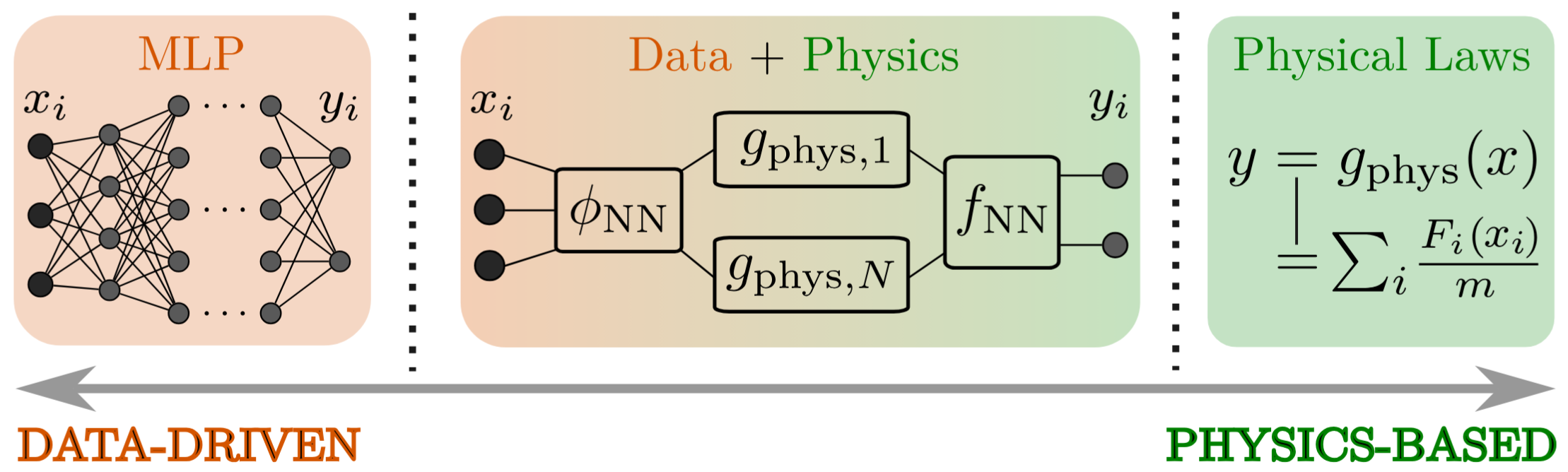
Machine learning is transforming robotics, advancing modeling, perception, decision-making, and control. Yet purely data-driven methods often struggle to generalize in safety-critical domains with limited training data. A growing body of research therefore seeks to integrate prior physics-based knowledge and engineering principles directly into learning systems. Such physics-aware approaches promise improved interpretability, generalization, and sample efficiency by combining the flexibility of data-driven methods with the principled structure of physics-based models.
The workshop Data Meets Physics at IROS 2026 will bring together researchers from robotics, machine learning, and control to explore emerging paradigms that tightly integrate learning with physical modeling. Discussions will center on embedding domain knowledge into learning frameworks, moving beyond black-box models by incorporating physics-based priors into architectures, data generation, and training processes. Through invited talks, a round table, and a poster session, the workshop will foster exchange among faculty, early-career researchers, and practitioners, promoting collaboration and highlighting open challenges in developing robotic systems that learn effectively from limited data by leveraging physical insights.
Confirmed Speakers


Full Professor
University of California, Berkeley, USA
Associate Professor
ShanghaiTech University, China

Research Scientist
Generative Bionics, Italy
Associate Professor
Delft University of Technology, The Netherlands
Program
The workshop will involve five invited talks from leading professors, early-career researchers, and industry practitioners. A poster spotlight will give authors of contributed papers a 1-minute pitch, leading to a poster session.
The workshop will feature a round-table panel on:
The Small-Data Bottleneck: Is Physics the Path to Real-World Generalization?
The workshop will be held in-person in Pittsburgh, USA. Additionally, we welcome the audience to join virtually via Zoom.
| Time | Event | Notes |
|---|---|---|
| 08:30 - 08:35 | Opening | Welcome introduction (5 min) |
| 08:35 - 09:00 | Invited Talk 1 | 20 min + 5 min Q&A |
| 09:00 - 09:25 | Invited Talk 2 | 20 min + 5 min Q&A |
| 09:25 - 09:50 | Invited Talk 3 | 20 min + 5 min Q&A |
| 09:50 - 10:15 | Invited Talk 4 | 20 min + 5 min Q&A |
| 10:15 - 10:30 | Contributed Paper Spotlight | 15 min: ≈1 min per selected paper |
| 10:30 - 11:00 | Posters & Break | 30 min: Poster session + coffee |
| 11:00 - 11:25 | Invited Talk 5 | 20 min + 5 min Q&A |
| 11:25 - 12:25 | Round Table | 60 min: Panel discussion |
| 12:25 - 12:30 | Closing | Best paper award & farewell |
Call for Papers
This workshop aims to explore the synergies between data-driven and physics-based approaches in robotics. We invite submissions related to the following topics:
- Beyond black-box learning: How can we fuse physics-based knowledge with data-driven learning to enhance accuracy and generalization?
- Physics-informed, physics-encoded, physics-guided machine learning and neural operators: How can domain knowledge be injected into training loss functions, model architectures, constraints, or synthetic data generation pipelines?
- Physics-grounded foundation models for embodied intelligence: Can large-scale models be constrained or guided by physics to ensure safety, trustworthiness, and transferability to embodied systems?
- From correlation to causation: How can physics-driven machine learning approaches discover causal structures and enhance interpretability in decision-making?
- Applications and challenges across robotics domains: From modeling and state estimation to planning, control, and decision-making.
Papers must be prepared according to the IROS'26 format, and can have 4-8 pages. We also encourage submitting new ideas, even if not fully developed yet.
Papers will be evaluated for quality, relevance to the workshop theme, clarity, and whether claims are well-supported by theory or experiments.
All accepted contributions will be presented as posters during our poster session. Accepted papers will be posted on the workshop website, and will not be part of the IROS conference proceedings.
A Best Paper Award will be given to the best contributed paper, selected by the program committee based on its quality and significance in the context of the workshop topics. The awardee will receive a certificate in recognition of their contribution.
Organizers


Humboldt Post-doctoral Fellow
Technical University of Munich, Germany


This workshop is supported by the IEEE RAS Technical Committee on
Autonomous Ground Vehicles and Intelligent Transportation Systems,
and by the Italian FIS 2 Call, Grant Assignment Decree No. 1236 adopted on
01/08/2023 by the Italian Ministry of University and Research (MUR), for the project
“Structured neural network framework for modeling and control of autonomous systems - Neu4mes”
,
CUP E53C24003800001.

